
Using plants as models, our researches challenge the interdisciplinary frontier between biomechanics and developmental biology.

Interpretation of plant cells in the Arabidopsis shoot apical meristem “turning into bubbles”. Image by Yuchen Long (2020).
“Are Plant Cells Bubbles?”
Plant cells walls are under tension, and cell interior is inflated by very high pressure, i.e. up to 10 times of the atmospheric pressure. Despite different origins of mechanical properties and dynamics, plant cells are often compared to bubbles or balloons. Our team is vigorously testing the appropriateness of these analogies, and we use time-lapse bioimaging, in vivo biomechanical measurements and simple biophysical models to capture the complex dynamics of the pressure-driven growth of plant cells.
Multidimensional Plant Mechano-biology
Plant morphogenesis requires the coordination of genetics, signaling, biomechanics, metabolism, and environmental responses. To follow the dynamics of this holistic process, we are establishing an live imaging platform that allows continuous acquisition of biophysical parameters, tissue deformation, and cell fate progression by integrating atomic force microscopy (AFM), confocal laser scanning microscopy (CLSM) and fluorescence-lifetime imaging microscopy (FLIM). The multidimensional data acquired from this platform will bring new insights to the controlling mechanism of plant growth and development.
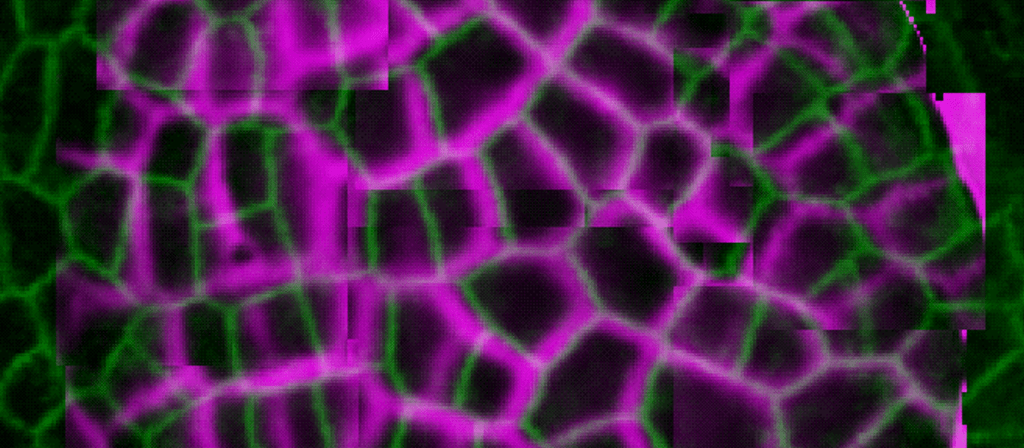
Unaligned overlay of cell wall stiffness (magenta) and plasma membrane marker (green) in the Arabidopsis shoot apical meristem, acquired by the AFM-CLSM imaging platform. Image by Nathanael Tan (2022).
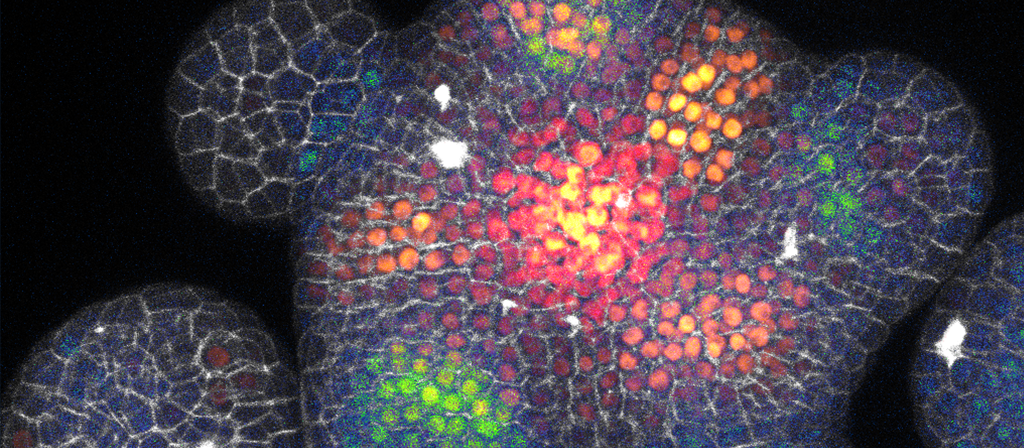
Image of a live Arabidopsis shoot apical meristem with five fluorescent markers of different tissue types and cell components. Biomaterial generated by Galvan-Ampudia et al. (2020).
Hydraulics in Plant Meristems
In 1965, Lockhart proposed that both cell wall mechanics and cell hydraulics are indispensable for growth regulation in plant cells. Whereas cell wall mechanics has been one of the main research areas in plant morphogenesis, the hydraulic input to the plant meristems, the ultimate sources of plant growth and development, has been largely overlooked due to technical challenges. To fill this gap, we employ molecular genetics and gene editing techniques to manipulate tissue hydraulics in Arabidopsis and test the hypothesis of the hydraulic-origin of meristematic regulations.
Biomechanics in Urban Farming
Singapore has launched its “30 by 30” initiative, where 30% of Singapore’s nutritional needs is to be to locally produced by Year 2030. Innovation in urban farming lies at the core to the solution. In collaboration with food scientists, engineers and local farmers, we aim to bring the fundamentals of plant biomechanics “to the field”. Indeed, biomechanical treatments to crop plants may overcome limitations in traditional or transgenics-based agricultural practices, and we believe that knowledge in plant mechanobiology can provide alternative solutions to classic agricultural challenges. We welcome new collaborations, please contact us for more information.
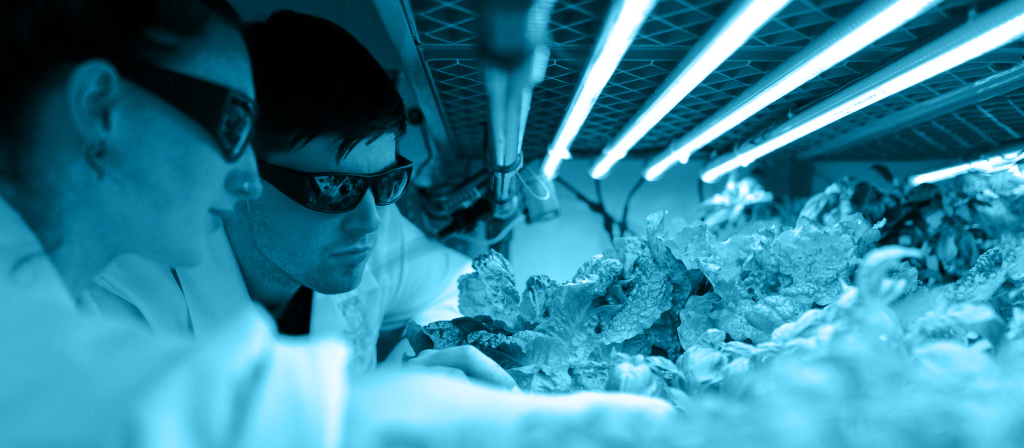
Stock image
Publications
2025
Harnvanichvech Y, Long Y (2025) Balancing growth with integrity: The tangle between brassinosteroid and FERONIA. Molecular Plant 18(7) 1112-1114.
Sun AR, Ramli MFH, Shen X, Kannivadi Ramakanth K, Chen D, Hu Y, Vidyasekar P, Foo RS, Long Y, Zhu J, Ackers-Johnson M, Young JL (2025) Hybrid hydrogel–extracellular matrix scaffolds identify biochemical and mechanical signatures of cardiac ageing. Nature Materials 24, 1489–1501.
Guo K, Zhang Y, Paradiso M, Long Y, Hsia KJ, Liu M (2025) Midveins regulate the shape formation of drying leaves. Journal of the Mechanics and Physics of Solids 206(A) 106391.
Long Y (2025) Yuchen Long. New Phytologist (in press)
2024
Zhang X, Kannivadi Ramakanth K, Long Y (2024) The biomechanics of turgor pressure. Current Biology 34(20) R986-R991.
2023
Kannivadi Ramakanth K, Long Y (2023) In preprints: shrinking boundary cells reveal fluid flux in organogenesis. Development 150 (21).
Ali O, Cheddadi I, Landrein B, Long Y (2023) Revisiting the relationship between turgor pressure and plant cell growth. New Phytologist 238(1): 62-69.
2022
Zhao F, Long Y (2022) Mechanosensing, from forces to structures. Frontiers in Plant Science 13.
Nieves-Cordones M, Azeem F, Long Y, Boeglin M, Duby G, Mouline K, Hosy E, Vavasseur A, Chérel I, Simonneau T, Gaymard F, Leung J, Gaillard I, Thibaud JB, Véry AA, Boudaoud A, Sentenac H (2022) Non-autonomous stomatal control by pavement cell turgor via the K+ channel subunit AtKC1. The Plant Cell 34: 2019–2037.
Nakayama H, Koga H, Long Y, Hamant O, Ferjani A (2022) Looking beyond the gene network – metabolic and mechanical cell drivers of leaf morphogenesis. Journal of Cell Science 135: jcs259611.
Mirabet V, Dubrulle N, Rambaud L, Beauzamy L, Dumond M, Long Y, Milani P, Boudaoud A (2022) NanoIndentation, an ImageJ Plugin for the Quantification of Cell Mechanics. In Plant Systems Biology: Methods and Protocols, Lucas M (ed) pp 97–106. New York, NY: Springer.
2021
Long Y, Xu J (2021) Nodulation: a SHORTROOT-SCARECROW perspective. Sci. Bull. 66(12): 1154-1156.
Lenne PF, Munro E, Heemskerk I, Warmflash A, Bocanegra-Moreno L, Kishi K, Kicheva A, Long Y, Fruleux A, Boudaoud A, Saunders TE, Caldarelli P, Michaut A, Gros J, Maroudas-Sacks Y, Keren K, Hannezo E, Gartner ZJ, Stormo B, Gladfelter A, Rodrigues A, Shyer A, Minc N, Maître JL, Di Talia S, Khamaisi B, Sprinzak D, Tlili S. (2021) Roadmap for the multiscale coupling of biochemical and mechanical signals during development. Phys Biol. 18(4).
2020
Long Y, Cheddadi I, Mirabet V, Mosca G, Dumond M, Traas J, Godin C & Boudaoud A (2020) Cellular heterogeneity in pressure and growth emerges from tissue topology and geometry. Curr. Biol. 30(8): 1504-1516.e8.
Long Y, Stahl Y, Weidtkamp-Peters S, Blilou I (2020) Visualizing Protein Associations in Living Arabidopsis Embryo. Chapter in Plant Embryogenesis in the series of Methods in Molecular Biology 2122: 167-188.
Publications before 2020
Zhao F, Chen W, Sechet J, Martin M, Bovio S, Lionnet C, Long Y, Battu V, Mouille G, Monéger F, Traas J (2019) Xyloglucans and Microtubules Synergistically Maintain Meristem Geometry and Phyllotaxis. Plant Physiol. 181(3):1191-1206.
Bovio S, Long Y, Monéger F (2019) Use of atomic force microscopy to measure mechanical properties and turgor pressure of plant cells and plant tissues. J. Vis. Exp. 149. doi: 10.3791/59674.
Long Y, Boudaoud A (2019) Emergence of robust patterns from local rules during plant development. Curr. Opin. Plant Biol. 47: 127-137.
Verger S, Long Y, Boudaoud A & Hamant O (2018) A tension-adhesion feedback loop in plant epidermis. eLife 7: e34460.
Long Y, Stahl Y, Weidtkamp-Peters S, Smet W, Du Y, Gadella TWJJ, Goedhart J, Scheres B & Blilou I (2018) Optimizing FRET-FLIM Labeling Conditions to Detect Nuclear Protein Interactions at Native Expression Levels in Living Arabidopsis Roots. Front. Plant Sci. 9.
Long Y, Stahl Y, Weidtkamp-Peters S, Postma M, Zhou W, Goedhart J, Sánchez-Pérez MI, Gadella TWJ, Simon R, Scheres B & Blilou I (2017) In vivo FRET-FLIM reveals cell-type-specific protein interactions in Arabidopsis roots. Nature 548: 97-102.
Díaz-Triviño S, Long Y, Scheres B & Blilou I (2017) Analysis of a plant transcriptional regulatory network using transient expression systems. Chapter in Plant Gene Regulatory Network in the series Methods in Molecular Biology 1629: 83-103.
Long Y, Goedhart J, Schneijderberg M, Terpstra I, Shimotohno A, Bouchet BP, Akhmanova A, Gadella TWJ, Heidstra R, Scheres B & Blilou I (2015) SCARECROW-LIKE23 and SCARECROW jointly specify endodermal cell fate but distinctly control SHORT-ROOT movement. Plant J. 84: 773–784.
Long Y, Smet W, Cruz-Ramírez A, Castelijns B, de Jonge W, Mähönen AP, Bouchet BP, Sanchez-Perez G, Akhmanova A, Scheres B & Blilou I (2015) Arabidopsis BIRD Zinc Finger Proteins Jointly Stabilize Tissue Boundaries by Confining the Cell Fate Regulator SHORT-ROOT and Contributing to Fate Specification. Plant Cell 27: 1185-1199.
Long Y, Scheres B & Blilou I (2015) The logic of communication: roles for mobile transcription factors in plants. J. Exp. Bot. 66: 1133–1144.
Cruz-Ramírez A, Díaz-Triviño S, Blilou I, Grieneisen VA, Sozzani R, Zamioudis C, Miskolczi P, Nieuwland J, Benjamins R, Dhonukshe P, Caballero-Pérez J, Horvath B, Long Y, Mähönen AP, Zhang H, Xu J, Murray JAH, Benfey PN, Bako L, Marée AFM & Scheres B (2012) A bistable circuit involving SCARECROW-RETINOBLASTOMA integrates cues to inform asymmetric stem cell division. Cell 150: 1002–1015.
Wang G, Long Y, Thomma BPHJ, Wit PJGM de, Angenent GC & Fiers M (2010) Functional Analyses of the CLAVATA2-Like Proteins and Their Domains That Contribute to CLAVATA2 Specificity. Plant Physiol. 152: 320–331.
 MechaPlant Lab